





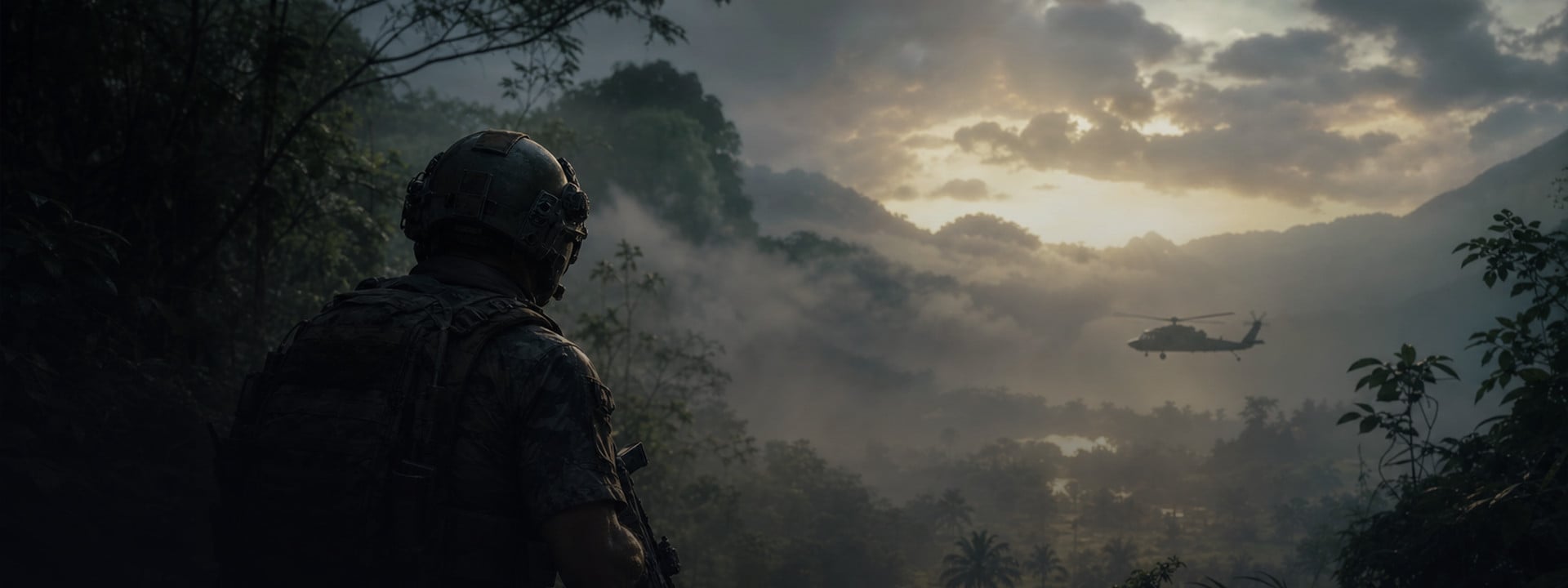
Gray Zone Warfare: Game, Modes, Map and Core Gameplay Loop
Quick answer: Gray Zone Warfare is a PvE-first, open-world tactical shooter with extraction mechanics. MADFINGER Games develops and publishes it for Windows PC through Steam Early Access. You deploy into the persistent 42 km² Lamang area of operations, complete tasks, fight AI, recover gear, build vendor reputation, and return safely. Joint Operations uses PvE rules. Warfare adds hostile players to the same basic loop. Use this guide to decide whether GZW's modes, gear stakes, and Early Access status fit how you want to play.
Current status: Windows PC Early Access | Live baseline: Patch 0.4.6.0 (deployed July 7, 2026), verified July 16, 2026 | Developer: MADFINGER Games
Source note: This guide separates features available in the current game from features that MADFINGER has only discussed for later development. Exact medical, task, helicopter, and recovery rules can change during Early Access.
🎯 What Is Gray Zone Warfare?
Gray Zone Warfare, often shortened to GZW, is a first-person tactical shooter set in the fictional Democratic Republic of Lamang. The official Steam listing calls it a "PvE-first open-world tactical shooter," while the official game overview also classifies it as a tactical sandbox extraction FPS.
The tactical, open-world, extraction, PvE-first, and sandbox labels describe different parts of the same game:
• Tactical shooter: weapon setup, ammunition choice, positioning, sound, injuries, and team communication affect each operation.
• Open world: Lamang is a persistent 42 km² area of operations rather than a small arena selected for one short round.
• Extraction FPS: you take equipment into the field, collect useful items, and risk losing carried gear if an operation goes wrong.
• PvE-first: AI combat, tasks, story, exploration, and progression sit at the center of the design, even though Warfare allows PvP.
• Sandbox: you choose where to go, which objective to pursue, and how much equipment to risk.
GZW entered Steam Early Access on April 30, 2024. Early Access matters here. The game is playable, but its systems, balance, content, performance, and progression can still change before the full release.
Is Gray Zone Warfare a conventional extraction shooter?
It has extraction mechanics, but its structure is broader than a sequence of isolated matches. The official world remains open while players pursue tasks, visit points of interest, fight AI, and move between field locations, landing zones, outposts, and their faction base.
Don't want to grind the loop? 🎯
Skip the repeat prep, deploy, and extract cycle and jump straight to the rank, vendor access, or gear you are working toward. A real player handles it manually on your own account, no bots, safe on Early Access. Rated 4.8/5 on Trustpilot (4,000+ reviews).
MADFINGER developers have described that distinction in interviews. In a PCGamesN interview, the persistent structure was compared with an MMO because it is "not match-based." The safest description is therefore an open-world tactical shooter with extraction mechanics, not a battle royale and not an offline campaign.
GZW is | GZW is not |
An online tactical FPS | An offline single-player game |
PvE-first, with a separate PvEvP ruleset | PvE-only |
Built around tasks, exploration, equipment, and reputation | A last-player-standing battle royale |
Set in a persistent open world | Limited to a string of fixed short rounds |
🔁 What Is the Core GZW Gameplay Loop?
Preparation, deployment, survival, extraction, and progression form the core GZW gameplay loop. The exact route changes with your objective, faction position, unlocked regions, and chosen mode, but the system chain stays recognizable.
1. Prepare: choose weapons, ammunition, armor, medical supplies, storage, and a task or contract.
2. Deploy: enter Lamang from your faction base, usually by helicopter to a discovered landing zone.
3. Operate: move toward the objective, identify threats, manage resources, and decide whether an encounter is worth taking.
4. Complete the objective: finish a task, collect an item, investigate a location, secure useful loot, or support your squad.
5. Extract: reach a safe departure option and return before another fight, injury, or poor decision costs the equipment you are carrying.
6. Progress: receive money or reputation, gain access to more stock and tasks, prepare a new loadout, and deploy again.
Phase | Main decision | What can change the outcome |
Preparation | What objective and gear should you take? | Task type, distance, expected threat, squad size, and replacement cost |
Deployment | Which route gets you close without exposing you early? | Landing zone, faction position, available outposts, and current activity |
Field operation | Should you fight, avoid, treat, or withdraw? | AI position, rival PMCs in Warfare, ammunition, injuries, time, and sound |
Extraction | Is the objective worth the risk of staying longer? | Gear value, task state, route safety, medical condition, and transport access |
Progression | What should you unlock or prepare next? | Money, vendor reputation, player rank, region access, and task prerequisites |
One deployment, in plain terms
Suppose you accept a task in an unlocked region and choose Joint Operations. You pack ammunition and medical supplies, fly to a nearby landing zone, then move from cover to cover toward the objective. AI resistance drains ammunition and may leave you injured. Once the objective is complete, staying for extra loot offers more value but also more exposure. If you leave safely, the recovered equipment and task rewards support the next operation. If you die, some or all of the carried value may be at risk.
The deployment example is not a fixed mission script. It shows the decision pattern GZW repeats: objective, preparation, field pressure, extraction choice, consequence.
⚔️ How Do Joint Operations and Warfare Differ?
Joint Operations is online PvE; Warfare is online PvEvP. The official modes FAQ states that either mode can be played solo or "in a squad of up to four players."
Feature | Joint Operations | Warfare |
Ruleset | PvE | PvEvP |
Main opponents | AI enemies | AI enemies and hostile players |
Can players attack one another? | No | Yes, subject to the live rules and active areas |
Can players loot one another? | No | Player looting can occur under the live Warfare rules |
Solo support | Yes | Yes |
Squad size | Up to four | Up to four |
Best fit | Learning systems, story, tasks, or cooperative play without hostile-player pressure | Players who want AI objectives plus the uncertainty of rival PMCs |
Joint Operations is not offline mode. It is an online PvE ruleset. Other players can be present, but they cannot attack or loot one another under the official mode rules.
Warfare is not a separate deathmatch. Tasks, AI threats, equipment decisions, movement, and extraction still matter. The difference is the added risk of hostile players.
The official sources reviewed for this article do not give enough current detail to claim that inventory, task, or vendor progress behaves identically across both modes. That specific cross-mode behavior should be checked in the live build before it appears in a detailed modes guide.
The planned Joint Operations versus Warfare guide will hold the version-tested mode rules so this foundational page does not compete with a dedicated comparison.
🗺️ What Are Lamang and the Three Factions?
Lamang is a fictional Southeast Asian country with a 42 km² area of operations and three playable PMC factions. MADFINGER describes the Democratic Republic of Lamang as a quarantined setting inspired by Laos in its official story and lore overview. The game world includes jungle, settlements, military sites, airfields, waterways, faction bases, landing zones, and other points of interest.
Three private military companies operate in Lamang:
Faction | Full name | Official identity |
CSI | Crimson Shield International | A results-led PMC with a hard-edged reputation |
LRI | Lamang Recovery Initiative | A publicly humanitarian recovery effort backed by a wealthy founder |
MSS | Mithras Security Systems | A soldier-run PMC that prizes field experience and shares rewards by standing and performance |
These descriptions are part of the game's fiction. They do not prove that one faction has better weapons, stronger characters, or hidden stat bonuses. Faction choice establishes your affiliation and starting context, but any current mechanical consequence should be checked against Patch 0.4.6.0 before making a permanent-choice recommendation.
Use the planned GZW faction comparison for a version-tested choice guide once that page is live.
The map is arranged around the three faction footholds and the wider push into more demanding regions. That supports a natural progression curve: early objectives teach the rules close to home, while later work sends you farther into areas with higher pressure and more valuable opportunities.
📈 How Do Tasks, Vendors and Gear Drive Progression?
Tasks, vendor reputation, player rank, and gear form GZW's progression system. Tasks and contracts provide objectives. Vendors connect reputation, stock, equipment, and regional access. Gear choices then affect how safely you can complete harder work.
The March 2026 Update 0.4 system rework reorganized this structure. MADFINGER reported more than 250 tasks and contracts after adding over 100 and updating more than 50. Update 0.4 also linked vendor reputation and player rank to access for regions, tasks, equipment, and vendor stock.
The result is a connected progression model:
Tasks and contracts produce money and reputation. Reputation and rank open stock, regions, and harder objectives. Better access broadens your loadout choices. A better-matched loadout improves your odds of finishing the next objective.
Stuck at a progression wall? 🧗
Vendor-reputation gates, region locks, and long task chains can stall you for hours. Let a real player clear the wall on your own account, done manually with no wipe risk, and most orders start within hours.
Main tasks, side tasks, and contracts
• Main tasks move the central progression and story structure forward.
• Side tasks provide optional objectives and more context around Lamang.
• Contracts offer simpler work from the current task pool, subject to live prerequisites and availability.
Patch 0.4.5.0 also added selected squad task sharing. Squad task sharing does not apply to every task. Participating squad members must meet the stated server, region, vendor, and prerequisite conditions.
Why gear knowledge matters
Weapons alone do not define a loadout. Ammunition, armor, medical supplies, storage, weapon parts, expected range, and replacement cost all affect the decision. The right question is not simply, "What is the best gun?" It is, "What equipment fits this objective, route, threat, and budget?"
The vendor-task-gear relationship puts access, progress, and equipment knowledge in the same system. A stronger item is only useful if you understand its ammunition, protection, treatment, or risk tradeoff.
💀 What Makes Death and Extraction Matter?
Death can cost carried equipment, while extraction protects the value recovered during an operation. GZW uses a detailed health model instead of a single conventional health bar. The official health guide describes wounds, blood loss, damaged body parts, symptoms, and coma. Update 0.4 and later patches have changed parts of the medical model, so exact treatment order and timing need live-build confirmation.
The broad consequence is stable: an injury can reduce what your operator can see, hear, carry, aim, or survive. A squadmate may have time to treat a comatose operator, while a solo player has fewer rescue options. The decision to keep searching, complete one more objective, or leave immediately becomes more important as ammunition falls and symptoms worsen.
Death can put carried equipment at risk. Body recovery may offer a chance to retrieve it, but recovery rules, persistence, mode behavior, and disconnect cases have changed during development. Treat current body-recovery details as version-sensitive rather than assuming an old guide still applies.
Extraction therefore does two jobs:
1. It protects the useful equipment or loot you are carrying.
2. It closes the field portion of the operation so its rewards can support your next decision.
There is no prize for staying until every slot is full. A safe return with a completed objective often has more progression value than an unnecessary final fight.
🔗 How Do GZW Systems Connect During One Deployment?
Each GZW deployment links its mode, objective, route, loadout, health state, extraction decision, and progression result. The relationship can be expressed as one causal chain:
Mode and objective set the threat rules. Threat rules and route shape the loadout. The loadout sets your combat and treatment options. Combat and injuries change the extraction decision. Extraction or death changes retained value. Retained value, money, and reputation shape the next task and loadout.
If this changes | The next decision changes because... |
You switch from Joint Operations to Warfare | Rival-player risk affects route choice, sound discipline, and the value of staying exposed |
You choose a longer objective | Ammunition, medical supplies, transport, and replacement cost carry more weight |
Your squad shares an eligible task | Objective coordination can reduce duplicated movement, but every member still needs the required access |
You suffer a serious injury | Treatment and withdrawal can become more valuable than extra loot |
You unlock a new vendor tier or region | New stock and objectives can justify a different loadout and route |
This causal chain is what makes GZW more than a gear-collection exercise. The game repeatedly asks you to trade objective value against exposure, replacement cost, medical condition, and the ability to leave safely.
🖥️ Where Is GZW Playable Now?
As of July 16, 2026, Gray Zone Warfare is available for Windows PC through Steam Early Access. MADFINGER's platform FAQ says the studio is focusing on the PC version first.
MADFINGER has said that consoles are part of its plans, but the console FAQ does not confirm a PlayStation or Xbox release date. The FAQ also does not confirm a specific console list, console editions, or cross-platform play. Any site displaying a firm console date without a newer developer announcement is speculating. The planned GZW console status page will track future official changes.
Current version and Early Access limits
The current verified baseline is Patch 0.4.6.0, deployed on July 7, 2026 through the official Steam announcement. Patch 0.4.6.0 reworked onboarding for completely fresh accounts and fixed a distant-rendering issue at UNLRA Headquarters. Patch 0.4.6.0 did not announce a new mode or a replacement for the Update 0.4 progression structure.
No exact full-release date is confirmed. MADFINGER also uses global wipes before major updates when development requires a broad progression reset. A wipe can reset tasks, reputation, money, items, and progress. Global wipes make patch and verification dates essential on any GZW guide.
Question | Current verified answer |
Is GZW on PC? | Yes, on Windows PC through Steam Early Access |
Is GZW on PS5? | No confirmed release or release date as of July 16, 2026 |
Is GZW on Xbox? | No confirmed release or release date as of July 16, 2026 |
Is GZW fully released? | No, it remains in Early Access |
What live version was checked? | Patch 0.4.6.0 |
🚀 Where Should a New Player Start?
New players should start with the current patch notes, a replaceable loadout, one clear objective, and an extraction plan. Joint Operations removes hostile-player damage and looting, making it the clearer place to learn the interface, medical system, map, tasks, and extraction flow. Warfare is the better fit when the added uncertainty of rival PMCs is part of the appeal.
Before the first serious deployment:
1. Read the current patch notice instead of relying on a launch-era video.
2. Learn what your ammunition and medical items do before filling the rest of the loadout.
3. Take an objective you can identify on the tactical map.
4. Treat extraction as part of the plan, not an afterthought.
5. Risk equipment you can replace while you learn the route and injury rules.
This page gives you the system model. Continue with the Gray Zone Warfare beginner guide for Patch 0.4.6 for the first-deployment order, onboarding limits, and next guide links.
Source and review record
• Primary sources: MADFINGER Games, the official GZW support center, and the live Steam product and patch channels.
• Secondary context: a direct developer interview published by PCGamesN.
• Factual baseline: Patch 0.4.6.0, checked July 16, 2026.
• Editorial limit: detailed task failure, body recovery, helicopter, outpost, and medical timings require recorded Patch 0.4.6.0 gameplay before publication in system-specific guides.
Gray Zone Warfare and its related names, marks, and assets belong to MADFINGER Games. ArmadaBoost is an independent service provider and is not endorsed by or affiliated with MADFINGER Games.
🪖 Ready to Enter Lamang?
Skip the grind 🚀
Let a real player push your rank, vendor reputation, tasks, or currency while your account stays yours. Manual work, no bots, safe on Early Access. Rated 4.8/5 on Trustpilot (4,000+ reviews), with most orders started within hours.
If you're still learning, use the beginner guide first and keep your opening loadouts easy to replace.

 Success

 Data
updated
Data
updated